
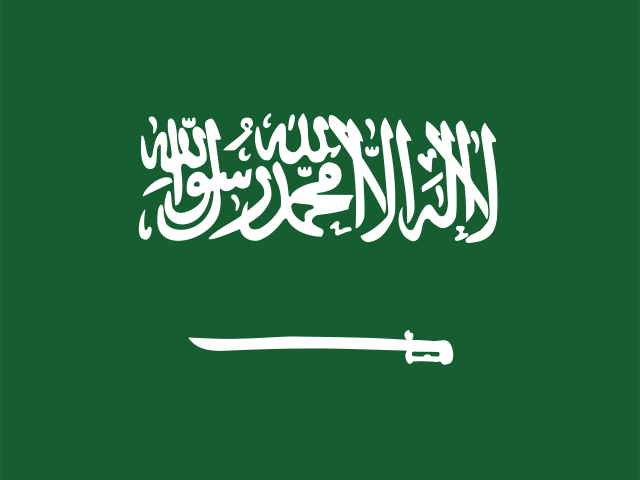
 Saudi Arabia
 appears in 1 reel. Here is where it lands in each one, and the figure the chart gives it.
Saudi Arabia at a glance
- People
- 37 million
- 2025
- Income per person
- $34,537 a year
- 2025
- Life expectancy
- 79.0 years
- 2024
- Live in cities
- 85%
- 2025
- Land area
- 2,149,690 km²
- 2024
Saudi Arabia over time
Compare Saudi Arabia with other countries →Population
37 million
people, 1990–2025
Income per person
$34,537
US$ a year, 1990–2025
Life expectancy
79
years, 1990–2024
Babies per woman
2.31
births per woman, 1990–2024
Baby deaths
4.7
per 1,000 births, 1990–2024
Living in cities
84.6%
% of people, 1990–2025
Internet users
100%
% of people, 1990–2024
Access to electricity
100%
% of people, 1990–2024
CO₂ per person
18.48
tonnes a year, 1990–2024
Unemployment
3%
% of workers, 1991–2025
Data: The World Bank, World Development Indicators (CC BY 4.0), updated 8 Oct 2026. Get the data
Who compiles these figures
- Population: World Population Prospects, United Nations (UN); Statistical databases and publications from national statistical offices, National Statistical Offices (NSOs); Eurostat: Demographic Statistics, Eurostat (ESTAT); Population and Vital Statistics Report (various years), United Nations (UN). Part of this series is modelled or estimated by its publisher, and the World Bank does not mark which years.
- Income per person: Country official statistics, National Statistical Organizations and/or Central Banks; National Accounts data files, Organisation for Economic Co-operation and Development (OECD); Staff estimates, World Bank (WB). Part of this series is modelled or estimated by its publisher, and the World Bank does not mark which years.
- Life expectancy: World Population Prospects, United Nations (UN); Statistical databases and publications from national statistical offices, National Statistical Offices (NSOs); Demographic Statistics, Eurostat (ESTAT). Part of this series is modelled or estimated by its publisher, and the World Bank does not mark which years.
- Babies per woman: World Population Prospects, United Nations (UN); Statistical databases and publications from national statistical offices, National Statistical Offices (NSOs); Demographic Statistics, Eurostat (ESTAT). Part of this series is modelled or estimated by its publisher, and the World Bank does not mark which years.
- Baby deaths: UN Inter-agency Group for Child Mortality Estimation, UN Children's Fund (UNICEF); World Health Organization (WHO); World Bank (WB); United Nations (UN). Part of this series is modelled or estimated by its publisher, and the World Bank does not mark which years.
- Living in cities: World Urbanization Prospects, United Nations (UN). Part of this series is modelled or estimated by its publisher, and the World Bank does not mark which years.
- Internet users: World Telecommunication/ICT Indicators Database, International Telecommunication Union (ITU).
- Access to electricity: SDG 7.1.1 Electrification Dataset, World Bank (WB).
- CO₂ per person: EDGAR (Emissions Database for Global Atmospheric Research) Community GHG Database, Joint Research Centre (JRC) - European Commission; International Energy Agency (IEA).
- Unemployment: ILO Modelled Estimates database (ILOEST), International Labour Organization (ILO). Part of this series is modelled or estimated by its publisher, and the World Bank does not mark which years.
Height to architectural top, metres
The 5 tallest buildings on Earth
Burj Khalifa is 149 metres taller than the runner-up, and 5.6 times the Great Pyramid.
Source: CTBUH Skyscraper Center · October 2026
- Makkah Clock Tower#4 of 5
- 601
